
How to Use AI to Write Small Business Website Copy
How to use AI to write website copy for a small business: rewrite your home and services pages in your own voice, and catch every claim it invents.

Your website says "quality service you can trust." So does the one down the street.
Here is how to use AI to write website copy for a small business. Give it a one page sheet of true facts about your business, one paragraph of your own writing to copy, and one page to write at a time. Put the same prompt to three models in one thread in Magai, keep the best answer, and check every claim against your sheet before anything goes live.
Think of your website as the front counter of your shop. A stranger walks in, and the person behind the counter says "quality service you can trust." Nobody hires that person. They turn around and walk out, and you never find out they were there.
You know how this evening usually goes. It's after closing, the reviews need answers, the job ad is half written, and the email about the price change is due tomorrow. The website has sat on that list for two years because writing about yourself is miserable.
AI is good at miserable. It is bad at knowing things about you.
A model can't write what it has never been told, so it fills the gap with the average of every website it has read. You get "passionate about delivering results." You get a founding year that isn't yours. You get "free estimates" on a business that charges for them.
The job is not to get AI to write your website. The job is to hand it enough of the truth that it has nothing left to invent.
The rest of this is how to do that for your home page and your services pages in one evening, with every prompt typed out.
Write website copy with AI from a facts sheet, not a blank box
To keep this concrete, the walkthrough uses a made up business: Alder Street Plumbing, three people, two vans, one mid sized town. Swap in your own details as you go.
Before you open a chat, open a notes app. You are writing one page of facts. Fragments are fine and typos are fine.

The sheet holds nine things:
- What you do, in one plain sentence, the way you'd say it to a neighbor.
- Who calls you and what they call about.
- Where you work, including the towns you turn down.
- What it costs, or at least how you price: flat rate, hourly, or a quote after a visit.
- How fast you respond and how long a typical job takes.
- How someone hires you, from the first call to the invoice.
- What you don't do.
- Proof you can document: exact years, license numbers, insurance, certifications.
- Your hours and the fastest way to reach you.
Number seven saves you the most. If you don't touch water heaters, put that on the sheet and the model has a reason to leave them out.
Here is what a finished sheet looks like for Alder Street. It's ugly on purpose:
WHAT WE DO: Residential plumbing repair: drains, leaks, toilets, faucets.
WHO CALLS: Homeowners and landlords with a clog, a leak, or a dead faucet.
WHERE: [Town] and the two towns next to it. Nothing past 20 miles.
PRICE: $89 visit fee, credited to the job if you hire us. Flat price quoted before work starts.
SPEED: Same day for anything leaking. Next day for everything else.
HOW TO HIRE: Call or text. We book a visit, quote on site, you approve, we work, invoice by email.
WE DON'T: Water heaters, commercial buildings, new construction.
PROOF: Licensed since 2016, license #[number]. Insured.
HOURS: Weekdays 7 to 6. Emergency line for current customers only.
If typing a page of facts sounds like the same misery, don't type it. Make the model interview you. Paste this into a new thread in Magai:
I own a small business and I need to rewrite my website. Before you write any copy, interview me. Ask one question at a time about: what we do, who calls us and why, where we work and where we don't, how we price, how long jobs take, how someone hires us from the first call to the final invoice, what we do not do, and what proof I can document. If an answer is vague, ask a follow up. When I type "done," write everything I told you as a plain fact sheet in my own words. Do not add anything I did not say.
Answer the way you'd answer on the phone. When you type "done," you have the sheet.
Read it once and fix what's wrong. This is the one place where your correction is worth more than the model's cleverness. Then ask yourself one more thing out loud: what would a customer need to know before calling that the sheet doesn't say? Add the answer.
Then save it. Paste it at the top of every thread about your website, or keep it as a file you attach each time.
Every gap in this sheet is a place for the model to guess. Leave out your years in business and it may hand you a number. Leave out whether estimates are free and it can promise one in your name. A sheet with holes produces copy with lies in it, and the lies sound confident.
The same facts first habit is what makes AI listing descriptions for real estate agents usable, and it works for any business that sells something specific.
Put your customers' own words in the thread
Your customers describe your business better than you do. They say "my kitchen sink backed up on a Sunday." You say "comprehensive drain solutions."

Gather the raw material before you write a line of copy:
- Ten of your best Google reviews, pasted as plain text.
- Five emails or texts where someone asked what you do or what it costs.
- The questions you answer on the phone every week, written from memory.
- Any note you jotted after a job that went well, in your own shorthand.
Paste them in the same thread under a heading that says Customer words. Then send this:
Below are real reviews and messages from my customers. Do not rewrite them. Pull out: (1) the exact words they use for the problem they had before they called me, (2) the exact words they use for what I did, (3) the questions they asked before hiring me, and (4) any detail they mention that belongs on my website, like speed, price, or showing up on time. Quote their words. Label anything you are guessing.
Judge the reply on one thing: are those quotes? If the model hands back a smooth summary like "customers value responsiveness," tell it to quote them exactly. A summary can't go in a headline. The raw phrase can.
For Alder Street, imagine "showed up the same day" turns up in four of the ten reviews. That's no longer a guess about what to lead with. Your customers already told you.
Short on reviews because the business is new or your customers are shy? Use the texts and emails above, plus your call notes. You can also text three recent customers one question each, such as "What was going on before you called us?" You want their words, not their stars, so don't offer anything for a good answer.
One line you don't cross. Don't ask AI to write a testimonial. The Federal Trade Commission's staff guidance on its rule on consumer reviews and testimonials, in effect since October 21, 2024, says a business that puts testimonials on its own website is disseminating them, and if they are fake or false, the business could be liable. The same guidance warns that using non-representative reviews in marketing could be deceptive.
So quote only real customers, in their words, and choose the ones that sound like a typical job and not your best day in ten years. This isn't legal advice. It is a rule worth writing into your agent, and that comes next.
If the reviews are the part of the job you dread most, how to use AI to respond to guest reviews runs the same raw material through a different task.
Give it your voice in one paragraph
Voice is where AI website copy goes flat. The facts can be right and the page still sounds like a stranger wrote it, because a stranger did.
Pick one paragraph you wrote that sounds like you. An email to a customer. A reply to a review. A text to a regular. Don't pick anything you wrote as marketing, because marketing is where you were already pretending.

Paste it with this:
Here is a paragraph I wrote that sounds like me. Describe my voice as eight rules a writer could follow: sentence length, words I use, words I never use, how I address the customer, how much I joke, and how I talk about price. Show a before and after sentence for each rule. Then list ten phrases that would sound wrong coming from me.
Look at what comes back. If the reply is adjectives (warm, professional, approachable), push back and ask for rules. Adjectives give a writer nothing to do. "Sentences under fifteen words, 'we' for the company and 'you' for the customer, never says 'solutions'" is something a model can follow and you can check.
For Alder Street, a good rule reads like this: "Open every page with what the customer gets, never with who we are." Another: "Say 'plumber,' never 'plumbing professional.'" Another: "Put the price, or how we price, on the first screen of any services page." You can mark each one pass or fail by reading the page. That's the test for every rule you keep.
Now do the thing that saves the rest of your evening. Put the voice rules, the fact sheet and a never list into one agent. In Magai, an agent is a reusable set of instructions that runs on any model, so your voice holds whether the next reply comes from Claude, GPT or Gemini. The build is short, and how to build an AI agent step by step covers the screens. Give it these instructions:
You write website copy for [Business name], a [one sentence on what we do] in [town].

Voice rules:
[paste the eight rules]

Facts: use only the fact sheet below and the text I paste under Customer words. If a page needs a fact that is not there, write [NEED: what is missing] in its place. Never invent years in business, license numbers, awards, guarantees, prices, hours, response times, or "free" anything.

Never write a customer testimonial, a star rating, or a quote. Only use quotes I paste, word for word.

Banned phrases: quality service, trusted partner, passionate about, solutions, one stop shop, committed to excellence, second to none, [add your own].

Format: plain words, short paragraphs, one idea per paragraph, no exclamation marks.

Fact sheet:
[paste the sheet]
The line that earns its place is the NEED rule. It turns the model's urge to invent into a to-do list. Instead of "over 20 years of experience" you get "[NEED: years in business]," and you fill in the true number or cut the sentence.
The testimonial line is the FTC point from the last step, written as an instruction, so you never have to remember it at 9 p.m.
Everything typed so far, plus the prompts for the pages ahead, sits in one pack so you don't have to scroll back through this post when you sit down to do the next page.
Draft the top of the home page first
Visitors give your home page a glance. Jakob Nielsen's research at the Nielsen Norman Group, first published in 1997, found that 79 percent of test users always scanned a new page and only 16 percent read it word by word. The first screen decides it. Everything below is for the few who stay.
So write that screen first, and write it for a skimmer. It has to answer four questions without a scroll: what you do, who it's for, where you work, and how to hire you.
With your agent loaded in the thread, or the sheet pasted in, type:
Using only the fact sheet and the customer words in this thread, write the top of my home page. Give me a headline of ten words or fewer that says what we do and where. Give me a two sentence subheading that says who we help and what happens when they call. Give me the label for the one main button. Write three versions that take different approaches: one plain, one that opens with the customer's problem in their own words, one that opens with how fast we respond. Mark any fact you needed that is not on my sheet as [NEED: ...].
Three versions on purpose. A model's first answer leans toward the most common phrasing. Asking for versions that differ in approach pushes it past the average, and you get to choose instead of edit.
For Alder Street, the three headlines might come back like this (invented for the walkthrough):
- Plumbers in [Town], here when the sink backs up.
- "Showed up the same day." That's what our customers say.
- Two vans, three plumbers, one number to call.
Read each one to someone who knows nothing about your business and ask what we sell. The one that gets the right answer wins, even if you like another better.
The button label deserves a second look. "Submit" and "Learn more" tell a customer nothing. "Call now" or "Book a visit" says what happens next.
Then build down the page in pieces, in the same thread, one prompt each:
- "Write the how it works strip from the hiring steps on my sheet. Three steps, one sentence each, no adjectives."
- "Write the what we fix section from the services on my sheet. One line per service, in my customers' words for the problem."
- "Write the proof section. Pick three quotes from Customer words and give them back word for word. Do not fix their grammar."
- "Write the closing block: the main action again, the phone number, and the hours."
Ask for pieces, because one request for a whole page gets you a page shaped average. Pieces give you control, and each one is short enough to check against the sheet at a glance.
Let three models compete on the same page
Treat the first draft as a candidate. The comparison is what you keep.
In Magai, you send the home page prompt once, then send it again with /Claude at the front, again with /GPT, and again with /Gemini. Each reply lands in the same thread, so the sheet and your voice are already in front of every model. Nothing gets pasted twice. All three families are in Magai today.
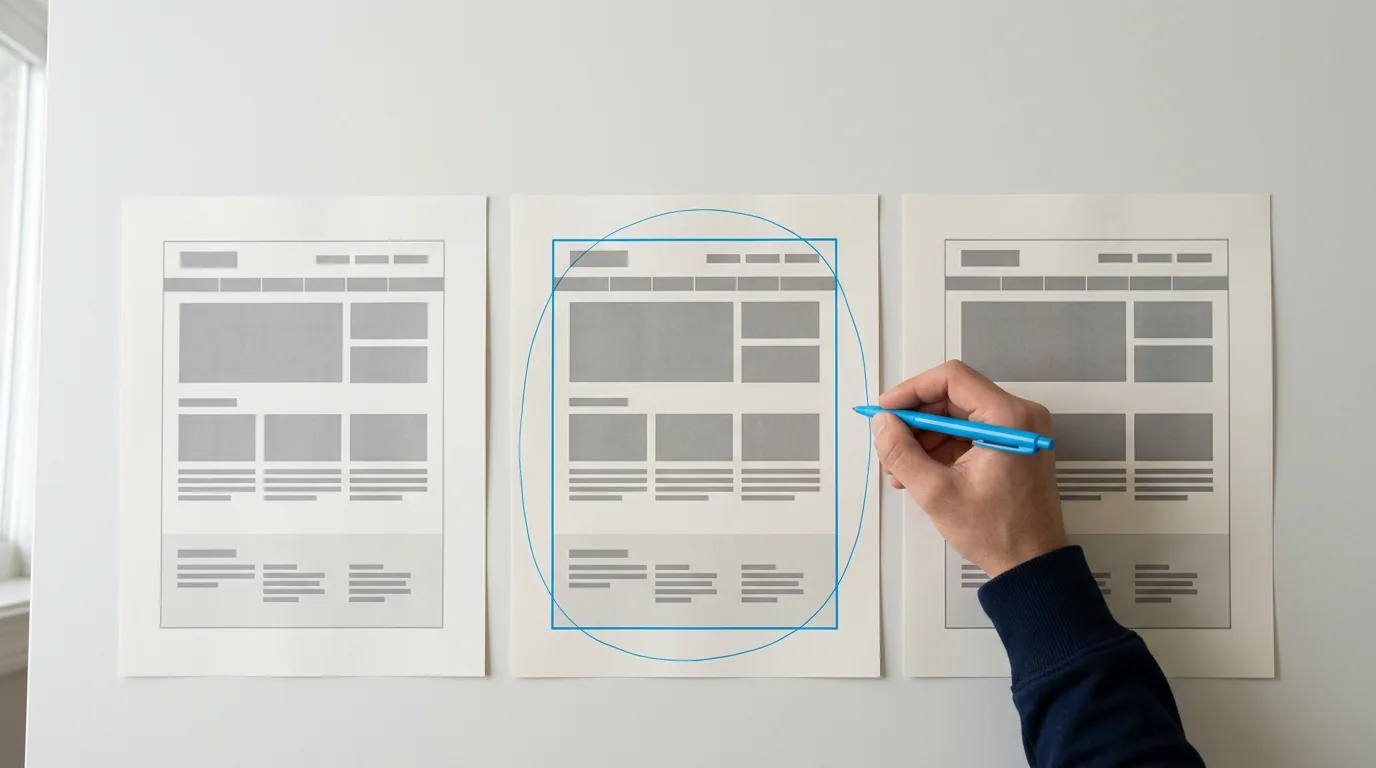
Try that across separate chat apps and each one starts blank. You paste the sheet three times, and somewhere around the second paste you tweak it, so the models aren't working from the same facts anymore.
Separate subscriptions to ChatGPT Plus, Claude Pro, Gemini Advanced, SuperGrok and Perplexity Pro add up to about $100 a month, and what you tell one stays in that one. One Magai plan starts at $20 a month and keeps the thread whole when you switch.
Score each reply on five tests. Keep this by the keyboard:
| Test | A pass looks like | A fail looks like |
|---|---|---|
| First line | A stranger can say what you sell | Needs a second read |
| Customer words | At least one phrase lifted from your reviews | Generic praise |
| Facts | Nothing on the page that isn't on your sheet | A year or a guarantee you never gave it |
| Voice | You'd say it out loud to a customer | Sounds like a brochure |
| Next step | One clear action on the first screen | Three buttons and no priority |
Give each test a 0, 1 or 2 and add them up. Trust the facts row over the total. A lovely version with an invented guarantee scores zero where it matters.
The three replies give you a bonus check. A claim that shows up in one reply and not in the other two is the first place to look for an invention.
Then pick by page, not by vendor. The model that wrote the best headline can write a flat services page. Keep the best line from each reply and have the one you trust do the stitching: "Use the headline from the second reply, the subheading from the first, and the button label from the third. Keep everything else from the first reply."
You end up with a page no single model wrote, and that's the point. You chose it. Your job ad is on tonight's list too, and how to use AI to write job descriptions runs the same comparison on it.
Rewrite each services page from the same sheet
A services page has one job: let a customer decide whether to call. That takes six answers. What do I get, who is it for, what does it cost or how is it priced, how long does it take, what happens first, and what don't you do.

Send this once per service, in the same thread:
Write the services page for [service]. Start with what the customer gets in plain words. Then say who it is for, how pricing works, how long it takes, what happens from the first call to the finished job, and what we do not do. Use my customers' words for the problem from the Customer words section. Then write five questions customers ask before hiring us for this and answer each in under 50 words. If a fact is missing, write [NEED: ...]. Keep the whole page under 350 words.
The "what we do not do" line pays twice. It saves you calls from people you can't help, and it makes everything else on the page believable. A business that says what it won't do reads as one that knows what it does.
Price deserves its own sentence. If you won't print a number, print how you price. For Alder Street, "We quote after a visit, and the $89 visit fee comes off the job if you hire us" is more useful than "call for pricing." (That policy is invented for the walkthrough. Use your real one.)
Say the drain page comes back opening with: "Slow or backed up drain? We clear it the same day you call, for a flat price we quote before we start." Judge it against the sheet. The sheet says same day for anything leaking and next day for everything else, so a slow drain that isn't leaking is a next day job, and the line over promises. The fix is one message: "Same day only applies when water is leaking. Next day for the rest. Rewrite the opening." That is also why the sheet's SPEED line carries the rule in detail and not just the word fast.
Take the five questions from your phone list under Customer words, and tell the model so: "Use the questions I pasted, not ones you think of." Those are the questions real people ask before they hire you, and a model's guesses are the questions people ask about the average business.
The second service page is one prompt, because the sheet and your voice are already loaded. The third is the same. This is where the agent from earlier pays for itself: you aren't describing your business again, you're only naming the service.
Run the three model comparison on the pages that matter most, which are the service people call about most and the one that earns you the most. For the rest, take the first draft from the model whose headline won on the home page, then move on to the check. The check is not optional.
Check every claim before it goes live
A model will write a confident sentence about a fact it was never given. Treat every number, license, guarantee and promise as guilty until you find it on your sheet.
Here is a sample first draft of the kind a model writes when the sheet is thin. I wrote this one to show the pattern, and yours will differ:
We offer drain cleaning backed by over 20 years of experience. Our licensed and insured plumbers are available 24/7 and give free estimates on every job.
It reads fine. It's also four claims you never made. Run the check in a different model than the one that wrote the page, so you get a second reader and not an echo. Send this:
Here is a draft page and here is my fact sheet. List every factual claim in the draft as a table with three columns: the claim, whether the fact sheet supports it (yes or no), and the line in the sheet that supports it. Treat years, licenses, insurance, guarantees, prices, hours, awards, response times, and the word "free" as claims. Do not fix anything yet.
Against the Alder Street sheet, a good audit comes back something like this:
| Claim in the draft | On the sheet? | What you do |
|---|---|---|
| Over 20 years of experience | No. The sheet says licensed since 2016 | Use the real number or cut it |
| Licensed and insured | Yes, with a license number | Keep it and add the number |
| Available 24/7 | No. The sheet says weekdays 7 to 6, plus an emergency line for current customers | Rewrite to say exactly that |
| Free estimates | No. The sheet says an $89 visit fee credited to the job | Rewrite to say that |
Anything marked No is your decision, not the model's. Either you make it true on the sheet because you do offer it, or you cut it from the page.
The usual suspects are worth knowing by name, because they come back in draft after draft: "family owned," "locally owned and operated," "serving the area since," "award winning," "satisfaction guaranteed," and "fast response times" with no number behind them. Each one is a claim, and each one is yours to confirm or cut. "Fast" is the sneaky one. If you can't put a rule behind it, such as same day for leaks, it says nothing, and the SPEED line on your sheet should supply the real phrase.
This matters past the page. Google's guidance on helpful content asks of your pages, "Does the content have any easily-verified factual errors?" A customer who finds one starts doubting the rest. And a "24/7" promise you can't keep is a phone call at 2 a.m. from someone who believed you.
Fix the page by sending the audit back: "Rewrite the page so every claim matches the sheet. Where the sheet is silent, write [NEED: ...]." Then fill in the NEED lines yourself, with true answers or by cutting.
Run the audit a second time on the rewrite. It costs one more message, and it catches the rewrite that quietly brought a claim back. When the table comes back all yes, the page is safe to publish.
Read it like a stranger on a phone
You're close. A few checks left, and they take about as long as a coffee.
First, the five second test. Open the home page on your phone, show it to someone who doesn't know your business for five seconds, then take it away and ask what you sell and what they'd do next. If they can't say, the first screen is still wrong.

Second, read it out loud. If you stumble, the sentence is wrong. If it sounds like a brochure, the paragraph is wrong.
Third, cut. The Nielsen Norman Group tested five versions of the same site in that study and measured usability against a promotional control. The version with about half the word count measured 58 percent better, a scannable layout 47 percent better, and plain, objective language 27 percent better. Combined, the three measured 124 percent better. Let the agent make the first cut:
Cut this page to half its words without losing a single fact from my fact sheet or changing a customer's quote. Keep the headline. Remove any sentence that would work as well on a competitor's site as it does on mine.
Fourth, search the page for the words on your banned list. "Solutions" sneaks back in, and so does "committed to." Use find on the page and fix them by hand, because asking the model again can bring back a cousin of the same phrase.
One more prompt belongs in this pass, because it writes the part of your site a search result shows:
From this finished page, write a page title under 60 characters and a description under 155 characters. Put the service and the town in both, say what the customer gets, and use only facts from my sheet.
Check the character counts yourself, then paste both into your website builder's page settings.
Then walk the buy path. From any page, can a customer call, text or book without scrolling or hunting? Tap your phone number on your phone. Does it dial?
Copy has limits. If the page says what you do and how to hire you, and nobody calls, wording is not the problem. Look at your Google listing, your photos and your price. But a page that makes a stranger work to understand you will lose to one that doesn't, and this is the cheapest part to fix.
Next page, same thread
What you built tonight outlasts the pages. You have a fact sheet, an agent that holds your voice, and a scorecard. Those are what make the next page cheap.
Next week you type something shorter: "Write the About page from the sheet. Mark anything missing as [NEED]." Then the page for the town you just started serving, then the answer to a review that landed this morning. The sheet and the voice are already loaded, and the thread remembers what you decided last time. If you're deciding what else to hand to AI after the website, five jobs to hand it first ranks them for a shop your size.
When something changes, a new price, a new town, new hours, change it once on the sheet inside the agent. Every page you write from then on is right. That's the whole maintenance plan.
Your site still says "quality service you can trust." Tonight it doesn't have to.
Open Magai, paste the interview prompt, and answer nine questions the way you'd answer a neighbor. Put someone useful behind the counter: start at app.magai.co.
More in AI for Business

AI for Business
How to Use AI for Sales Prospect Research: One Page
How to use AI for sales prospect research: turn a company's public pages and news into a one page brief, with every claim dated and checked.

AI for Business
How to Use AI to Write Grant Proposals, Facts First
How to use AI to write grant proposals from the funder's guidelines and your own records, with every figure traced to a source file.

AI for Business
How to Use AI to Write Job Descriptions, Week First
How to use AI to write job descriptions from a hiring manager's notes: build the posting around a real week, compare models, and audit every line.