How to Use AI for Contract Review, Clause by Clause
How to use AI for contract review: compare a draft to your firm's standard, catch missing clauses, and draft client questions. Verify every quote.
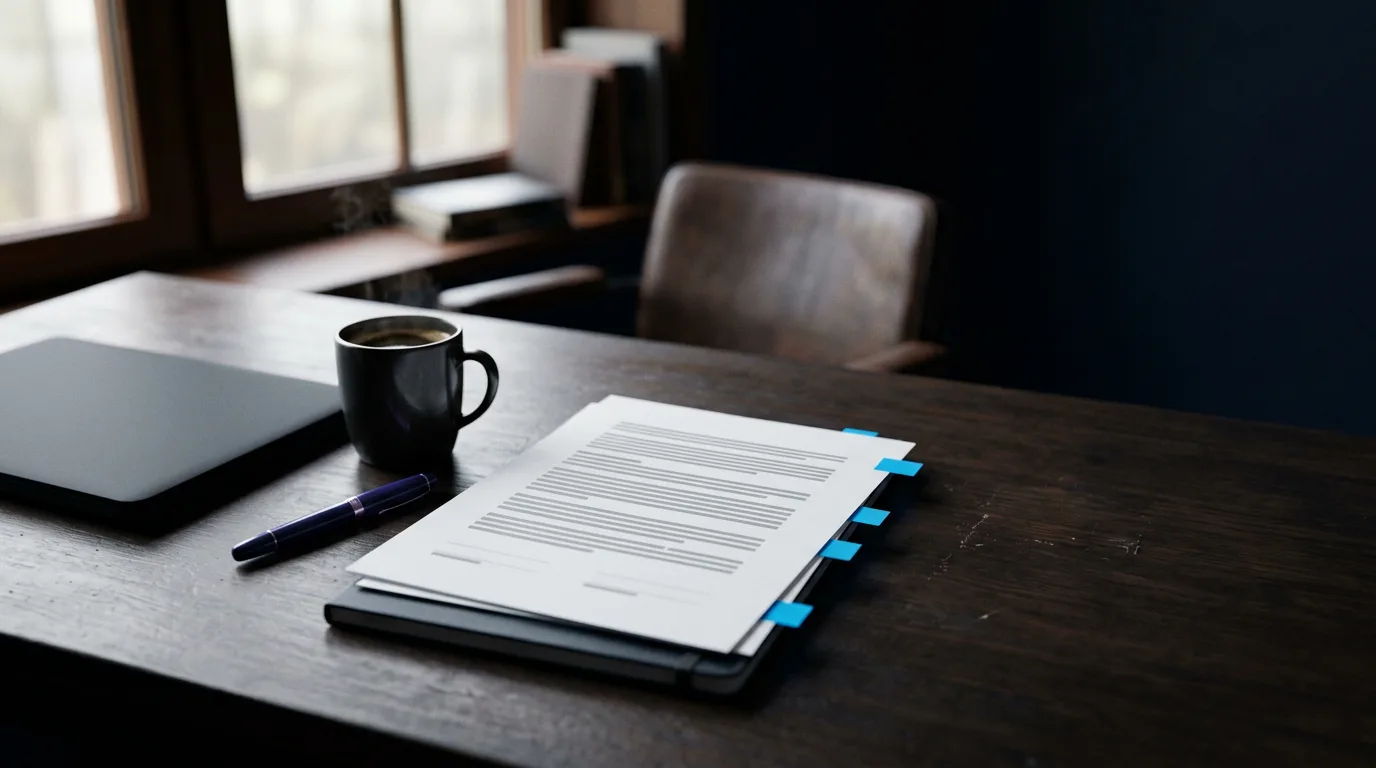
You have a vendor agreement due back by noon and a client who wants it explained in plain English by two.
That is a first pass, and it is the right job to hand to AI for contract review: read the draft, compare it to what your firm accepts, flag the gaps, work out what to ask the client.
It is also where one lazy prompt wastes your morning. Type "review this contract" and you get a tidy summary of a document you already have open.
Here is how to use AI for contract review so it gives you the hour back: give the model your firm's standard and the contract, and ask where the two disagree. Make it quote every clause it relies on, and make it say "not found" when a clause is not there. Then check each quote against the original.
Don't ask it to review. Ask it to compare.
A comparison gives you something to check. The model tells you which clauses depart from your playbook, which positions the draft never mentions, and what the client has to decide. You make every call. You just make them from a list instead of a blank page.
One care line before the steps. The agreement in this post is invented, with no real parties and nothing privileged. This is a workflow and not legal advice. Treat any citation, case or figure the model produces as something to confirm in the source before it goes anywhere.
Decide what goes into the thread before anything does
The rule comes before the prompt, because it decides what you are allowed to upload.
The American Bar Association's Formal Opinion 512, issued July 29, 2024, does not ban generative AI. It applies the Model Rules you already follow. Competence means a reasonable understanding of what the tool can and cannot do. Confidentiality means weighing the risk of disclosure before you input anything that relates to a client's matter.
The part to read twice is about consent. For what the opinion calls self-learning tools, it says a client's informed consent is required before you input information relating to the representation. Boilerplate in an engagement letter is not enough. The opinion also tells you to read the tool's terms of use and privacy policy yourself, or to ask someone who has.
So here is what Magai's say. Magai does not use your prompts, files or the replies to train any model, from any provider on the platform. Conversations stay private to you and the teammates you invite.
That answers one question the opinion raises. It does not answer yours. Whether your client has to consent, what your firm's policy allows, and what your state bar adds on top of the ABA are your calls. Some lawyers swap party names and figures for placeholders before they upload. Whether you do is between you and your client.
Two more lines from the opinion belong on a sticky note. You stay fully responsible for the work, whatever level of review you choose. And if you bill by the hour, you bill the time you spent, not the time the model saved you.
Pick whichever model you like for the first read. The second reader, later in the thread, is a different model on purpose.

Write your standard down so the model can read it
Your standard lives in your head and in the margins of old redlines. A model has neither.
Without it, a model is a temp on day one. Fast, well read, and no idea what your firm accepts. It reviews against the average of every contract it has ever seen, so it will not tell you that fifteen days is short for this client. It does not know what your client's accounts payable team can do.
So write the standard down. One page, numbered positions, each saying what you want, what you will accept and what you will not. Numbered, because you are about to ask the model to answer position by position.
Write each position so a stranger could apply it. "Reasonable liability" fails that test. "At least 12 months of fees" passes. A position with a number, a fallback and a line that does not move gives the model nothing to interpret and gives you something to check.
Here is a first version for a customer side vendor agreement. It has six positions, and the sixth line is a good place to look later.
Playbook: Customer-side vendor agreements

1. Payment. Target net 45 days. Net 30 is acceptable. Anything shorter needs partner approval.
2. Renewal. Auto-renewal is acceptable only with one-year terms and no more than 30 days' notice of non-renewal.
3. Limitation of liability. The provider's cap is at least 12 months of fees. The cap is mutual. Carve-outs: confidentiality breach, data breach, indemnity obligations, gross negligence, willful misconduct.
4. Indemnity. Mutual. The provider covers IP infringement and data breach claims.
5. Governing law. The customer's home state (Ohio). A neutral state is negotiable. The provider's home state is not.
6. Data breach. The provider notifies the customer within 72 hours of discovery and pays notification costs.
Each position is one fact you can check against one clause. Position 5 shows the shape: the target, the fallback and the line that does not move.
Save it as a Word document or a PDF and call it playbook. Then upload it into the thread. This is the capability the whole method leans on. A file in the thread means the model works from your document, not from its memory of what contracts usually say. And because the file stays in the thread, it is still there when you switch models.
Do not paste the playbook into every prompt. A file is something you edit once and attach again. The same habit carries a consulting job in how to write a consulting proposal with AI, where discovery notes go in as a file for the same reason.

Attach the contract and make the model prove it read it
The sample is four pages and thirteen numbered sections: a services agreement between Harbor Light Analytics, the provider, and Northfield Home Supply, your client. It was written for this post with problems planted in it. The steps below say which ones the review caught and which it missed.
Upload the agreement into the same thread as the playbook. Before you ask for any review, ask for proof of reading.
Before you review anything, tell me how many pages you read in the attached agreement, then list every numbered section heading. Do not summarize.
The reply:
I read 4 pages. The agreement has 13 numbered sections: 1 Definitions, 2 Services, 3 Fees, 4 Payment, 5 Customer Responsibilities, 6 Intellectual Property, 7 Term and Renewal, 8 Warranties, 9 Limitation of Liability, 10 Indemnification, 11 Notices, 12 General, 13 Entire Agreement.
Count the pages on your original. The sample has four, and the thirteen headings match the document.
If the count is off, stop there. A scan with no text layer, or a file that dropped a page, gets a confident review of whatever the model could see. Fix the file before you ask another question.
One more probe takes ten seconds. Pick a clause and ask for it back.
Quote Section 9.1 in full.
9.1 Limitation of Liability. Provider's total liability arising out of this Agreement shall not exceed the fees paid by Customer in the three (3) months preceding the claim.
Compare it to the page. A model that can hand a clause back word for word has the text in front of it. A model that paraphrases or hesitates has not, and you have found that out before it cost you anything.
The same check is why you upload the contract as a file. Text pasted from a PDF can shed its numbering and headings, and the section numbers are how you will check the model's work.
AI contract review fails when you ask for a review
Before the real prompts, run the one most people start with. You need the reference.
Review this contract.
The reply, in part:
This is a services agreement between Harbor Light Analytics, Inc. and Northfield Home Supply, LLC. Key terms include a one-year initial term that renews automatically, invoices payable within 15 days, a limitation of liability for the provider, and an indemnity from the customer. Overall the agreement appears fairly standard. You may wish to consider adding provisions for force majeure, dispute resolution and assignment.
Read it with your playbook beside it. The first half restates the contract, which you can only check by reading the contract again. The second half is a wish list of boilerplate that your standard never asked for.
It never said fifteen days is short. It could not. It had no standard to measure against, so "fairly standard" meant standard for some average contract and not for yours.
Test any finding a model hands you against four properties. Does it name a place, so you can find it? Does it give the words, so you can verify them? Does it name the standard, so you can judge it? Does it state a verdict, so you can act? The summary above has none of the four.
That is the failure to design around. A summary invites you to trust it and gives you nothing to check it with.
Find the clauses that differ from your standard
Now the prompt that earns the hour. It asks, position by position, for the section number, the quote, the standard and a verdict.
You are reviewing for the customer's lawyer. Compare the attached agreement to the attached playbook, one position at a time. For each position give me: the section number in the agreement, a word for word quote of the operative sentence, what the playbook asks for, and whether the clause matches, differs or is silent. Quote only text that appears in the agreement. If you cannot find the clause, say "not found" and do not guess. Do not rewrite anything yet.
The reply came back as a table, reproduced here with the quotes shortened.
| Position | Section | The agreement says | Verdict |
|---|---|---|---|
| 1 Payment | 4.2 | "within fifteen (15) days of the invoice date" | Differs. The playbook targets 45 days. |
| 2 Renewal | 7.1 | "at least ninety (90) days before the end of the then-current term" | Differs. The playbook allows 30 days. |
| 3 Liability | 9.1, 9.2 | "the fees paid by Customer in the three (3) months preceding the claim" | Differs. Three months, no carve-outs, and 9.2 leaves the customer's own liability uncapped. |
| 4 Indemnity | 10.1 | "Customer shall indemnify and hold harmless Provider" | Differs. One way only. |
| 5 Governing law | 12.3 | "the laws of the State of Delaware" | Differs. The playbook targets Ohio and treats a neutral state as negotiable. |
| 6 Data breach | Not found | None | Silent. |
Check the quotes before you think about the verdicts. Search the original for each one. All five matched word for word, and the section numbers were right. That is why the prompt demands a quote and a "not found": a quote you can search is a claim you can falsify in seconds.
Then read "differs" for what it is. It means the clause departs from the target, and nothing more. Position 1 allows net 30, so fifteen days falls below the fallback and goes to a partner, as the playbook says. Position 2 allows 30 days' notice, so ninety is three times the limit. Position 5 is subtler. Delaware is a neutral state only if neither party is based there, and the model cannot know that unless you tell it. Add one line to the prompt: "The customer is based in Ohio and the provider in Texas."
Then ask for the part that takes judgment. The model drafts the order and you decide it.
Rank the differences by the customer's exposure, highest first. For each, one sentence on why. Mark which ones are business points and which are legal risk.
Highest exposure: 9.1 and 9.2 together, because the cap is one-sided and the customer's own liability is uncapped. Then 10.1, a one-way indemnity. Business points: 4.2 payment timing and 7.1 the renewal window. Lowest: 12.3, because the playbook treats a neutral state as negotiable.
Keep the first two. Question the third. The model called the ninety day renewal window a business point, and it is one. It is also the clause a client forgets, because a missed date renews the whole year. You may rank it higher than a model does, and the ranking is yours to change.

Find what is missing, and what your playbook never asked about
Differences are the easy half. A clause that is not there leaves nothing to quote, which is why a tired reader misses it. So ask for it separately, and add two checks a model does well because the answers sit inside the document.
List every playbook position where the agreement is silent. Then list every cross-reference in the agreement, such as "as provided in Section X," and tell me whether the section it points to exists. Then list every capitalized defined term used in the agreement that Section 1 does not define.
Silent: Position 6, data breach notice. Cross-references: Section 7.3 refers to Section 14.2. The agreement ends at Section 13, and there is no Section 14. Undefined terms: Section 9.2 uses "Confidential Information," which Section 1 does not define.
Two of those three hits were never in the playbook. Section 7.3 says fees are non-refundable "except as provided in Section 14.2," and Section 14.2 does not exist. Either a refund provision was cut from the draft or it was never written. Either way it is a question for the provider, and nobody had to ask the model for it by name.
Now the gap. The reply said nothing about data return and nothing about confidentiality. That does not mean the draft is fine. A review looks for what it is told to look for, and a playbook with six positions reviews six positions.
The undefined term in Section 9.2 is the clue. The draft uses a capitalized term for a clause it does not contain. Add the two missing positions to the playbook file:
7. Data return. On termination, the provider returns or deletes the customer's data within 30 days and certifies it in writing.
8. Confidentiality. Mutual. Survives three years after termination. Trade secrets stay protected for as long as they remain secret.
Upload the updated file and run the same silent check again. The reply: "Silent: Position 7, data return. Position 8, confidentiality. The agreement contains no confidentiality section."
That is the loop to keep. Every contract you review teaches you a position your playbook lacked. Add it, and the next review looks for it.
One more extraction turns the draft into a calendar. Dates and dollar amounts are where a client gets hurt quietly, and they are easy to pull because they sit in the text.
List every date, deadline, notice period and dollar amount in the agreement in a table. Give the section number, the figure, and a word for word quote.
Search each row against the original, the same as before. Then hand the verified table to the client with the dates that need a reminder circled. In the sample, the ninety day renewal notice is the one that belongs on a calendar the day the agreement is signed.
Switch models and let a second reader attack the first
You now hold a list, and one model wrote it. A model that wrote the list is a poor judge of it.
So switch. In the same thread, type /GPT at the start of your next message, or pick it from the model picker. The contract, the playbook and the first review are all still in the thread, so there is nothing to upload again. The context survives the switch, and the second reader starts with everything the first one had.
Another reviewer produced the findings above. Do not agree with them to be polite. Find anything they got wrong or missed in the attached agreement, quoting the clause for each. Then tell me which verdicts you would downgrade and why.
Ask a second model "does this look right?" and you have handed it the answer it is likely to give. That is why the prompt forbids agreeing and asks for faults. A sentence leads into the table, so here is how to read the reply by what it did.
| The second reader | What it means | What you do |
|---|---|---|
| Agrees and adds nothing | Less to worry about, not nothing | Spot check the quotes |
| Finds a new problem | Possibly real, possibly invented | Find the words in the contract yourself before you accept it |
| Contradicts the first | A clause worth your attention | Read it yourself and decide |
Two models agreeing is not proof. They can share a blind spot. Agreement lowers what you check, and disagreement points at where to check first.
When the two disagree, narrow the fight. Copy the disputed clauses into one message and ask each model to defend its reading in two sentences, quoting the words that decide it. You will often find the disagreement is about a definition, and a definition is something you can read.
You can run it in any order. Start with /Claude, challenge with /GPT, and send the disputed clauses to /Gemini. The reasoning behind a second pass is laid out in how to combine models for accuracy, and it holds here for the same reason: two readers fail in different places.

Turn the findings into questions the client can answer
The client does not want a table. The client wants to know what they have to decide, in words they use.
Leave a one line version of this prompt alone ("write questions for the client") and a model is likely to ask Northfield whether a three month liability cap is acceptable. The client does not know. They would write back "whatever you think is best," and you would lose a day finding that out. The fix is two instructions: ask only for facts, and never ask for a legal judgment.
Write the questions I need to ask Northfield Home Supply before I respond to Harbor Light. Plain English, no legal terms, one fact per question. Ask only what the client knows about their own business, their data and their payment habits. Never ask them to make a legal judgment. After each question, one line on why it matters.
The reply, in part:
- Can your accounts payable team pay a vendor invoice within 15 days? Your usual terms are 45. Why it matters: Section 4.2 sets 15.
- Do you want this agreement to renew on its own? Why it matters: the window to cancel closes three months before the term ends, so someone needs a calendar reminder.
- What customer information will Harbor Light handle for you: names, emails, purchase history, payment details? Why it matters: it decides how much the missing breach notice could cost you.
- If that information leaked, roughly how many people would you have to notify? Why it matters: it sizes the exposure behind the liability cap.
Keep all four. Each asks for a fact. None says "cap," "indemnify" or "Section 9." You decide the legal answer, and the client supplies the facts it depends on.
Then the plain English update the client asked for by two. One more message in the thread:
Using only the findings above, write a short email to the client in plain English. Say what we found, what we need from them, and what I will ask the provider to change. Do not give legal advice. Leave a blank for my recommendation.
The last line matters. The model leaves a blank and you fill it in. Your recommendation is yours to write.
Check every claim before it leaves your desk
This step makes the rest usable. Do it in this order.
- Search the original for every quote in the review. A quote you cannot find is a hit you throw out.
- For every "silent" or "not found," search the document yourself for the words that would prove it wrong: breach, delete, return, confidential.
- Compare every number to the source. Fifteen, ninety, three months. A model that misreads one number has misread the clause.
- Treat anything the model says about law as a lead. A statute, a case, "market practice" or "enforceable in Ohio" goes to your research tool and your own knowledge, never into the email.
- Mark the work product as AI assisted when you file it. Opinion 512 offers this as a training suggestion, so future readers know where the draft came from.

You may be thinking that if you have to search every quote, you may as well read the contract. Fair. You will still read the clauses that matter. What changes is that you read them as a short list of specific places, not four pages cold.
The fourth step is not abstract. In Mata v. Avianca, a federal court in New York sanctioned two lawyers and their firm on June 22, 2023. The penalty was $5,000, imposed jointly and severally, after a brief cited cases that did not exist. The order is entry 54 on the court docket.
A Stanford team later put numbers on the research problem. In Magesh and colleagues' study, published in the Journal of Empirical Legal Studies in 2025, commercial legal research tools hallucinated between 17% and 33% of the time.
That study measured legal research, where the model has to know the law. It did not test contract review. The authors list contract review among the tasks that still need benchmarks. They also note that for contract analysis the better test is faithfulness to the document in front of the model, not to facts about the world.
That distinction is why this method keeps the model inside the file. Every claim in the review can be checked against four pages you already have. The question moves from "is this real" to "did it read the page right," and a search box answers that. For the wider compliance picture, see AI document review for legal compliance.
Do not skip the test run. On contracts, the opinion says a lawyer who relies on a tool to review and summarize many lengthy contracts would not necessarily have to review the whole set by hand. The condition is that the lawyer earlier tested the tool on a smaller subset, reviewed those documents manually, compared the results, and found the tool accurate.
So spend the first week on agreements you have already reviewed. Run the method on three of them and compare. Where it missed something your own review caught, add the position to the playbook.
Set it up once and type one line next time
Everything above is one-time setup. Here is what you keep.
The playbook is a file. Keep the eight position version in a folder with your other vendor agreement material. Then let each review improve it, with one more prompt at the end of the thread.
Based on this review, which issues did I raise by hand that the playbook did not cover? Draft each as a new numbered position in the same format, with a target, a fallback and a line that does not move.
That prompt is how a six position playbook becomes an eight position one, and then a twelve position one.
The prompts become an agent. An agent in Magai is a reusable set of instructions that runs on any model, so you write the rules once: compare to the attached playbook, quote word for word, say "not found" instead of guessing, check cross-references and defined terms, never give legal advice. The steps are in how to build an AI agent without writing code. If this is your work every week, Magai keeps a page for lawyers and legal staff too.
The next time a vendor agreement lands at nine in the morning, you upload two files and type one line: "Run the first pass on this agreement against the playbook." The second reader is a model switch away. Open a thread at app.magai.co and try it on a contract you have already reviewed.
Day two, the temp has the handbook. Hand it your standard first, then spend your hour on the clauses that matter.
More in AI for Business

AI for Business
Use AI to Write Real Estate Listing Descriptions
How to use AI to write real estate listing descriptions: build a facts sheet, draft, audit every claim, clear fair housing and pick the best model.

AI for Business
AI for Small Business: Five Jobs to Hand It First
AI for small business, done as five jobs: customer replies, posts, quote follow-ups, numbers and procedures, in one thread that knows your shop.

AI for Business
AI Tools for Business: Pick the Job, Then the Tool
The best AI tools for business start with the job. Sort your work into six jobs, test three for two weeks, and pay for fewer tools.